

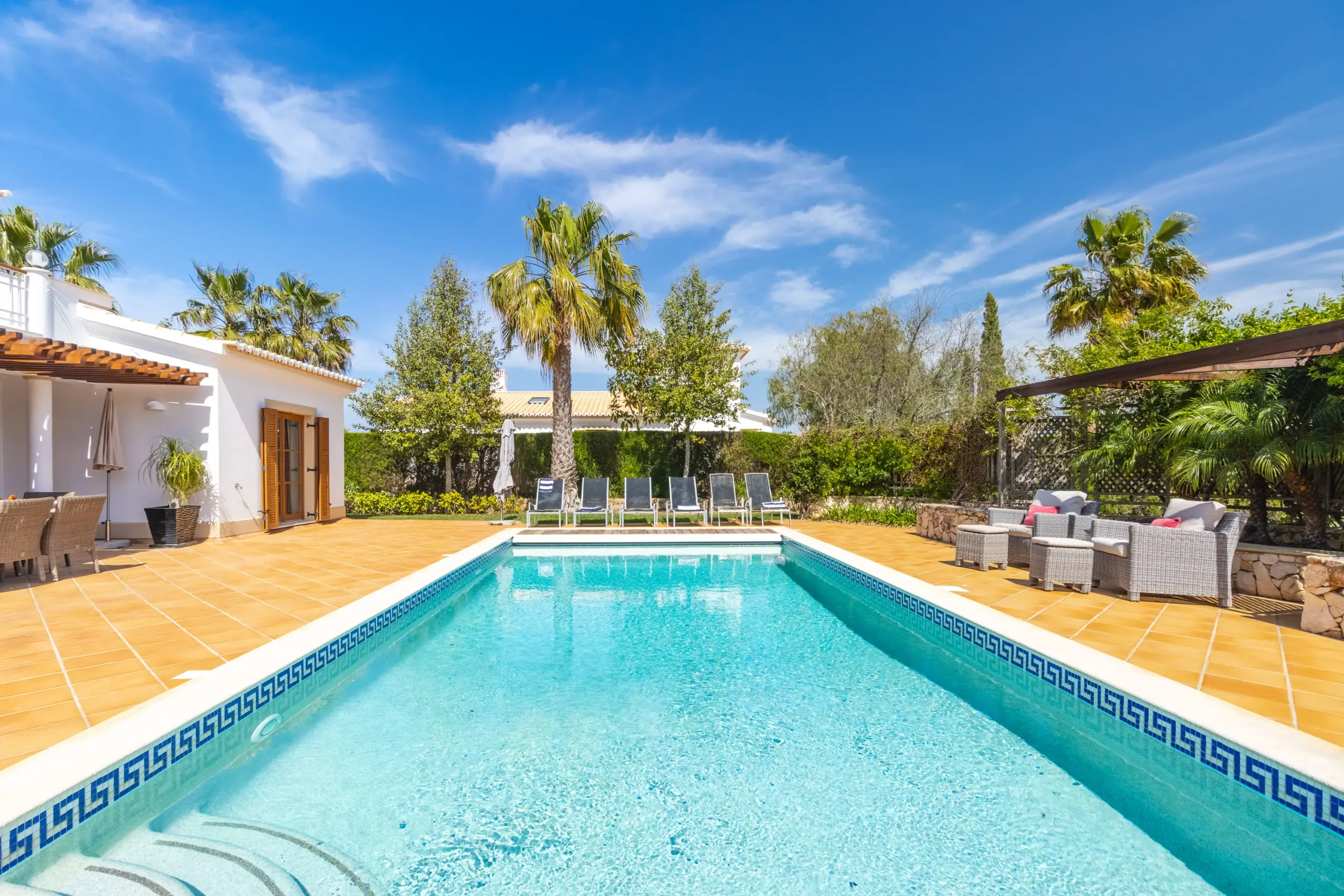
Pool costs are a line item owners tend to budget once and then leave alone. In practice, the figure moves quite a bit across the Algarve year, and the structure of the cost has a noticeable effect on net yield. The pool is one of the strongest demand drivers for a Lagos holiday let, but the cost of keeping it presentable is rarely the figure quoted in a glossy investment summary.
The numbers below reflect what we see across the Algarve holiday rentals we manage. They are working ranges, and individual properties vary by pool size, equipment, sun exposure and tree cover.
What the Annual Pool Bill Actually Covers
A pool costs money in five places, only one of which is the weekly clean.
- Weekly maintenance visits: chemical balance, brushing, filter check and visual inspection of equipment.
- Chemicals: chlorine, pH adjusters and algaecide, with consumption rising sharply in July and August.
- Electricity for the filtration pump, which runs longer hours in summer and is the largest variable cost owners overlook.
- Equipment replacement: pumps, filter cartridges, robot cleaners and the occasional pool light, spread across a five to ten year horizon.
- Pool opening and closing services in spring and autumn, particularly for properties with covers or seasonal use patterns.
For a standard 8 by 4 metre private pool at a Lagos villa in 2026, the combined annual figure usually lands between €2,800 and €4,200. The cleaning contract alone might be quoted at €1,800, the figure owners tend to remember; the rest sits on utility bills and the maintenance ledger.
How the Cost Moves Across the Year
Pool spend is heavily seasonal, and the shape matters for cashflow planning.
- January and February: minimal chemical use, lowest filtration hours, but cover maintenance and occasional algae treatment after rain events.
- March and April: pool opening, deep clean, filter service, replacement of any equipment that has failed over winter.
- May to September: peak filtration hours, peak chemical consumption, weekly cleans become twice-weekly at some properties during August.
- October and November: gradual wind-down, top-up chemicals to stabilise the pool before the cooler months, and a final clean.
- December: limited activity unless the pool is being heated for winter guest stays, in which case running costs are a separate question.
Roughly 65 per cent of annual pool spend lands between May and September. The first quarter often feels deceptively cheap and creates a misleading reference point for owners who only check the figures at the start of the year.
Where Pool Costs Show Up in Net Yield
Pool costs sit in the operating expenses line alongside cleaning, linen, utilities and AL compliance. For a Lagos villa with gross rental income of around €55,000 in 2026, a €3,500 pool bill is 6 to 7 per cent of revenue. That is meaningful but not catastrophic; the issue is that owners often forget to include it.
Two patterns recur with owners thinking about whether the figures stack up.
- Owners who self-manage tend to under-cost pool electricity, which can run €600 to €1,100 a year on its own for a private pool with summer-heavy use.
- Owners who only budget the headline cleaning contract typically underestimate the all-in cost by 40 to 60 per cent.
Pool spend is also a line where outsourced management consolidates supplier rates in a way single-property owners rarely match. Understanding repair responsibilities in holiday rentals is part of the same conversation, since equipment failures often sit in a grey area between routine and capex.
Heated Pools and Winter Use
Heating is a separate calculation. The cost of warming a typical Algarve private pool from October to April is well outside the standard maintenance budget. Whether to heat the pool turns on the booking pipeline, and the answer varies by property and target guest profile, particularly for owners chasing off-season rental returns through shoulder months.
A heated pool also raises chemical consumption (warmer water needs tighter chemistry) and pushes filtration hours up. The combined effect can add €1,200 to €2,000 a year on top of the gas or heat pump electricity bill itself.
Where the Numbers Quietly Move
A handful of factors push pool costs higher than the standard quote, and tend to come up only after the first full year of operation.
- Tree cover and bougainvillea proximity, both of which dramatically raise the cleaning workload.
- Older filtration equipment that draws more electricity for the same flow.
- Pool size: a 10 by 5 metre pool can run 40 per cent more expensive across the year than an 8 by 4.
- Salt chlorinator vs traditional chlorine: salt systems trade lower chemical costs against higher upfront equipment and a salt cell replacement every three to five years.
None of this changes the case for owning a pooled Algarve property. Pools are one of the most visible features in booking platforms, and a property’s standing on the national tourism register depends on basic safety compliance. The numbers simply ask to be set out properly in any yield calculation.
Summary
Pool maintenance is one of the operating costs that most rewards being budgeted in detail. The headline cleaning contract is usually only 50 to 60 per cent of the total, the spend is concentrated in summer, and the all-in figure has a real effect on net yield. Owners who plan around the full €2,800 to €4,200 range tend to make better decisions on pricing and capex timing.At Resort Rentals Algarve we manage the pool maintenance line for owners alongside the rest of the operational stack. If you would like a view on Maximising ROI on your investment property, or want to compare your current pool spend against what we see across the portfolio, please get in touch.